

Pixal3D: Pixel-Aligned 3D Generation from Images
Paper • 2605.10922 • Published • 33

LocalMesh Engine turns one photo, or four sides of the same subject, into a
textured .glb. It runs on an 8 GB NVIDIA card. The code is Apache-2.0 and
lives on GitHub. The project
page is local-mesh.com/localmesh-engine.
TRELLIS.2 works from a single image. This engine adds a four view path and, since version 1.2, puts the photographs' own pixels on the texture. This repository holds every weight the engine needs, except DINOv3 and the cutout model, laid out like the folder the engine reads. Most of it is rehosted unchanged; the three fp8 conversions of the Pixal3D multi-view models exist nowhere else.
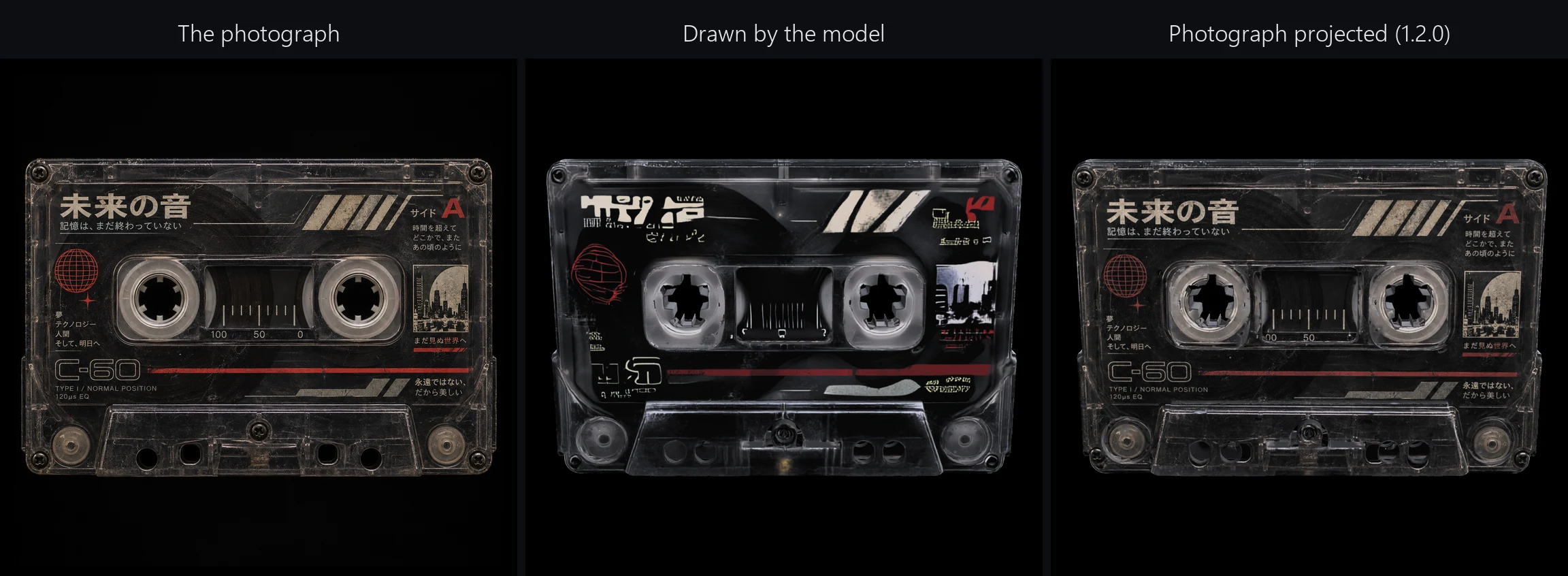
No new weights. Engine v1.2.0 reads exactly the files in this repository. A folder downloaded for an earlier version works as it is: there is nothing to download again.
The change is in the texture. The texture TRELLIS.2 returns is drawn by the model: close to the photograph in colour and shape, wrong in the detail, so printed text comes back as glyphs that read as nothing. After texturing, the engine now projects the photographs back onto the mesh. Every texel a photograph sees squarely takes that photograph's pixel, so a printed label, a logo or a fine pattern reads as it does on the photograph. Where no photograph sees the surface, underneath or on the back of a single photograph, the drawn texture stays, its colour pulled towards the photographed surface next to it. The photographs themselves are never retouched.
The cameras are fitted to the images. With four photographs, the engine reuses
the angles DA3-BASE (multivue/cameras/, listed below) measured for the shape;
when the shape was made without that measurement, on the max tier or without
DA3-BASE, it starts from quarter turns and checks whether the two profiles are
swapped. With one photograph, it searches the whole turn for the angle that
matches the silhouette and straightens a tilt of up to 20 degrees; nothing
under multivue/ is needed, so the single photo download gets the projection
too. One elevation is shared by all views, and the mesh is never mirrored to
fit. Each texel takes the one photograph that sees it most squarely, so
nothing is averaged into a blur. On a cassette generated from four
photographs, 59 % of the surface takes a photograph pixel, and its printed
label reads as it does on the photographs.
Beside model_<seed>.glb, the engine writes model_<seed>.ai.glb: the same
mesh with the drawn texture alone, to compare or to fall back on. Expect about
twice the disk per job. On an RTX 4060 Laptop 8 GB the projection adds 29 to 73
seconds per job, most of it spent fitting the cameras, and its memory peak,
3.3 GB, stays below that of the texture stage.
What it cannot do is correct a shape. Where the reconstructed mesh departs from
the photograph, a correct pixel lands on the wrong surface and that part shows
twice. For such a subject, --no-projection keeps the drawn texture alone. A
failure of this step never fails the job: the drawn texture is kept, and the
result says why.
Everything here is laid out exactly like the folder the engine reads, so one command places all of it:
| Folder | Size | What it is | Whose |
|---|---|---|---|
TRELLIS.2-4B/ |
8.1 GB | the single photo path, in fp8 | visualbruno, MIT, rehosted unchanged |
microsoft/ |
148 MB | the sparse structure decoder | Microsoft, MIT, rehosted unchanged |
multivue/ |
4.8 GB | the four view path | ours, from Pixal3D, see below |
Rehosted so that one hf download replaces six. Taking those two from their
own repositories works exactly as well; nothing here is modified.
multivue/
| File | Size | Source |
|---|---|---|
multivue/structure_mv_fp8.safetensors + .json |
1.39 GB | fp8 conversion of ckpts/ss_flow_img_dit_1_3B_64_bf16_mv.safetensors, TencentARC/Pixal3D |
multivue/forme_512_mv_fp8.safetensors + .json |
1.44 GB | fp8 conversion of ckpts/slat_flow_img2shape_dit_1_3B_512_bf16_mv.safetensors, TencentARC/Pixal3D |
multivue/forme_1024_mv_fp8.safetensors + .json |
1.44 GB | fp8 conversion of ckpts/slat_flow_img2shape_dit_1_3B_1024_bf16_mv.safetensors, TencentARC/Pixal3D |
multivue/champ.safetensors |
2.7 MB | valeoai/NAF, official checkpoint, tensors unchanged |
structure_mv_fp8 fuses the four encoded views into a sparse volume of
cells. Each view is projected onto the shared grid by its own camera.
forme_512_mv_fp8 is the first shape pass, on the grid inherited from the
structure. forme_1024_mv_fp8 is the second, and the TRELLIS.2 shape
decoder turns its latent into the mesh.
champ is the NAF field network. It returns a 512 by 512 query map, which
fills in the detail the token map loses: the token map is sixteen times coarser
than the photo.
4.28 GB, seven files, plus multivue/cameras/, 544 MB, rehosted unchanged:
DA3-BASE and the code that reads it (Apache-2.0), and the three small Python
packages that code needs, each under its own licence (omegaconf and
antlr4-python3-runtime BSD-3-Clause, addict MIT). Keep the three .json
descriptors next to their .safetensors: the engine builds each flow model on
the meta device from that descriptor, then loads the tensors in place, so the
weights are never held twice. The descriptors declare dtype: float8_e4m3fn.
The four view path serves the draft, standard and high tiers. The
multi-view weights exist at 512 and 1024 only, so max falls back to the
earlier way of blending the views rather than shipping a standard shape under
another name.
Two sets. The engine needs both.
| Weights | Where | Licence | Note |
|---|---|---|---|
| DINOv3 ViT-L/16 | https://huggingface.co/facebook/dinov3-vitl16-pretrain-lvd1689m | DINOv3 License, Meta | Image encoder, required on both paths. Access is gated and approved by hand, so ask for it first. |
| BiRefNet_HR | https://huggingface.co/ZhengPeng7/BiRefNet_HR | MIT | Cutout, and the mask that tells the projection which pixels belong to the subject. The engine fetches it from the Hub on the first generation if the cache is empty, and loads it with trust_remote_code=True, so that first run executes code from the Hub. |
TRELLIS.2-4B in fp8, the structure decoder and DA3-BASE are in this repository, rehosted unchanged. Their own repositories work just as well: visualbruno/TRELLIS.2-4B-FP8, microsoft/TRELLIS-image-large, depth-anything/DA3-BASE. Without DA3-BASE the engine guesses which side each profile is on, and says so in its result; a wrong guess puts a face at the front and at the back.
Set LOCALMESH_ROOT to the folder that holds models/, then:
pip install -U huggingface_hub
hf download Qtn-Cls/LocalMeshEngine --local-dir "$LOCALMESH_ROOT/models"
13.1 GB, and every file lands exactly where the engine looks for it. There is
nothing to move afterwards. For the single photo path alone, 8.3 GB, add
--exclude "multivue/*".
Then ask Meta for DINOv3, the one set you have to fetch yourself: it is gated, and a human grants access. Nothing generates without it, and approval is not instant, so send the request before anything else: facebook/dinov3-vitl16-pretrain-lvd1689m.
The layout the engine reads:
<LOCALMESH_ROOT>/models/
  TRELLIS.2-4B/                              this repository
  microsoft/TRELLIS-image-large/ckpts/       this repository
  multivue/                                  this repository
  multivue/cameras/                          this repository, DA3-BASE
  facebook/dinov3-vitl16-pretrain-lvd1689m/  from Meta, gated
  hf/                                        Hugging Face cache (HF_HOME), where BiRefNet_HR lands
Then, from the four sides of one subject:
python -m localmesh_engine face.png --right right.png --left left.png --back back.png --to out/
--tier picks the tier: draft, standard, high or max, written
Draft, Standard, Detailed and Extreme where these pages spell them out.
--seed sets the seed, --to the output folder. The command assumes the package is installed.
The four view path also needs natten. Installation, including the three CUDA
extensions that are not on PyPI, is written up in docs/INSTALL.md in the
GitHub repository; the four tiers, frozen, are in docs/RECIPES.md.
The photographs are projected onto the texture unless you ask otherwise:
python -m localmesh_engine photo.png --no-projection --to out/
--no-projection keeps the drawn texture alone; --sans-projection is the
same flag under its French name.


A full turn each. One pose can be chosen; a full turn cannot.
Six subjects, four photos each, high tier, RTX 4060 Laptop 8 GB: samurai on a
base, crowned stone head, sword in the stone, motorcycle, cassette with a clear
shell, traffic light.
| Tier | Four views, measured over the six subjects |
|---|---|
Standard, standard |
6 min 30 to 8 min 30 |
Detailed, high |
9 min 20 to 13 min |
Texture accounts for about 60 % of that time. These times were measured with engine 1.1, before the projection, which adds 51 to 67 seconds with four photographs.
The three flow models start from the official *_mv weights of
TencentARC/Pixal3D. Their tensors are stored in float32, despite the bf16 in
their filenames. The transformer blocks are cast to float8_e4m3fn, and the
descriptor beside each file records that dtype, so the engine builds the model
in fp8 rather than casting after the fact. Of each model, 480 tensors are
converted; the input and output layers, the norms and modulations, and the
structure model's complex rotary table are left as they were.
Measured against the source: RMSE of 0.025 to 0.026 on the weights, and 0.027 on a projection probe.
champ.safetensors is not converted. It carries the tensors of the official
valeoai/NAF checkpoint, naf_release.pth, unchanged, re-serialised to
safetensors. The file records the source URL and its SHA-256 in its own
metadata.
The license field above is the repository tag. It is Apache-2.0, the licence
of the engine code and of this card. The files themselves keep the licence of
their own source:
champ.safetensors comes from valeoai/NAF, Apache-2.0,
https://github.com/valeoai/NAFmultivue/cameras/ holds DA3-BASE and its source, Apache-2.0,
https://huggingface.co/depth-anything/DA3-BASE, and under deps/ three
Python packages, unchanged: omegaconf 2.3.0 (BSD-3-Clause, Omry Yadan),
antlr4-python3-runtime 4.9.3 (BSD-3-Clause, The ANTLR Project) and
addict 2.4.0 (MIT, Mats Julian Olsen)The engine also builds on:
Built with DINOv3. DINOv3 is the image encoder on both paths. Its weights are not redistributed here: request them from Meta, and ship a copy of the DINOv3 License Agreement with any redistribution of your own.
@software{colus2026localmeshengine,
  author  = {Colus, Quentin},
  title   = {LocalMesh Engine},
  year    = {2026},
  version = {1.2.0},
  license = {Apache-2.0},
  url     = {https://github.com/Quentincls/localmesh-engine}
}
The upstream work these weights rest on: TRELLIS.2 (Microsoft, arXiv:2512.14692), Pixal3D (TencentARC, arXiv:2605.10922), NAF (valeoai), DINOv3 (Meta), Depth Anything 3 (arXiv:2511.10647).
The engine is at https://github.com/Quentincls/localmesh-engine. Recipes, installation, measurements and the provenance of every vendored file are there. Open issues there, not here.
These weights and this engine are the generation core of LocalMesh, a Windows application at local-mesh.com: the same core with a board, a library and a viewer, installed in one step instead of fifteen. The engine is free and open; the application is what is sold.

Base model
TencentARC/Pixal3D