🌌 CorridorVLA
This repository provides the official implementation of CorridorVLA.
Direct spatial constraints for Vision-Language-Action models via sparse physical anchors



🔍 TL;DR
- Explore an alternative to common visual-style spatial guidance (e.g., predicting future images/videos) using text-style physical anchors
- Predict sparse end-effector Δ-positions
- Use them to impose an explicit corridor constraint on action generation
- Achieves 83.21% success rate on LIBERO-Plus
🧠 Motivation
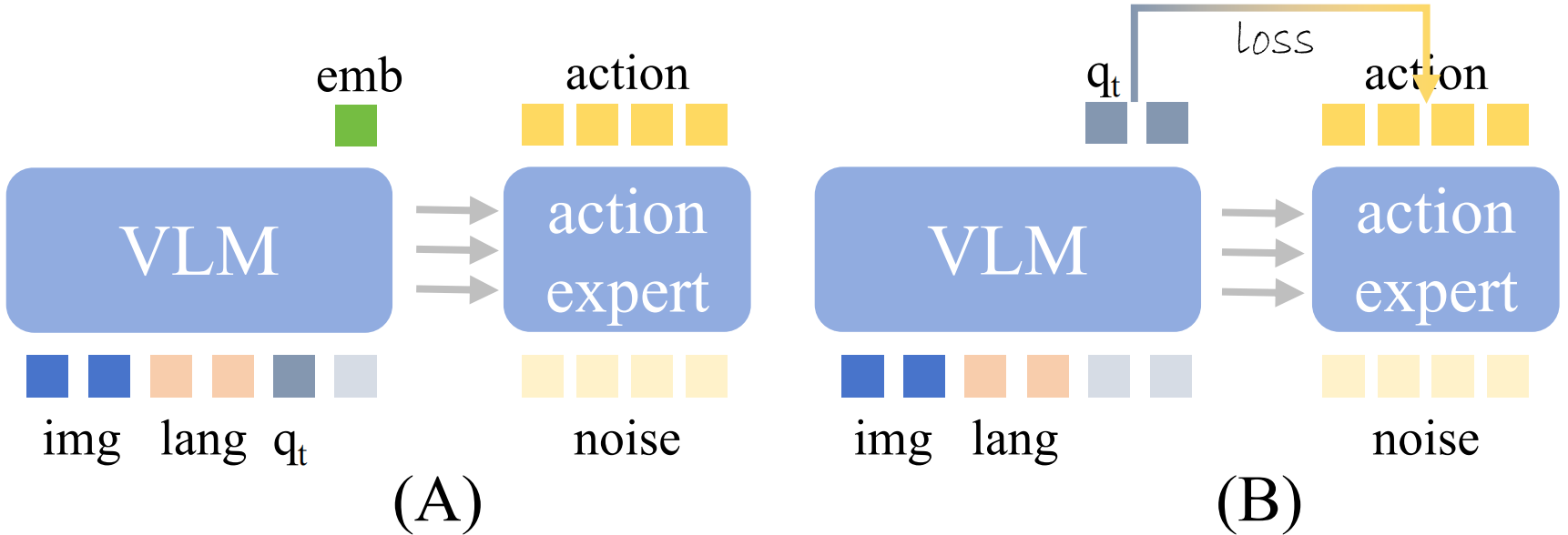
Existing VLA paradigm
- Spatial guidance is encoded as visual-style tokens or latent features
- Action generation is influenced indirectly through the backbone features
CorridorVLA
- Predict compact physical quantities (spatial anchors)
- Apply them as direct constraints in the loss
- No need for heavy visual intermediate representations
🏗️ Method Overview
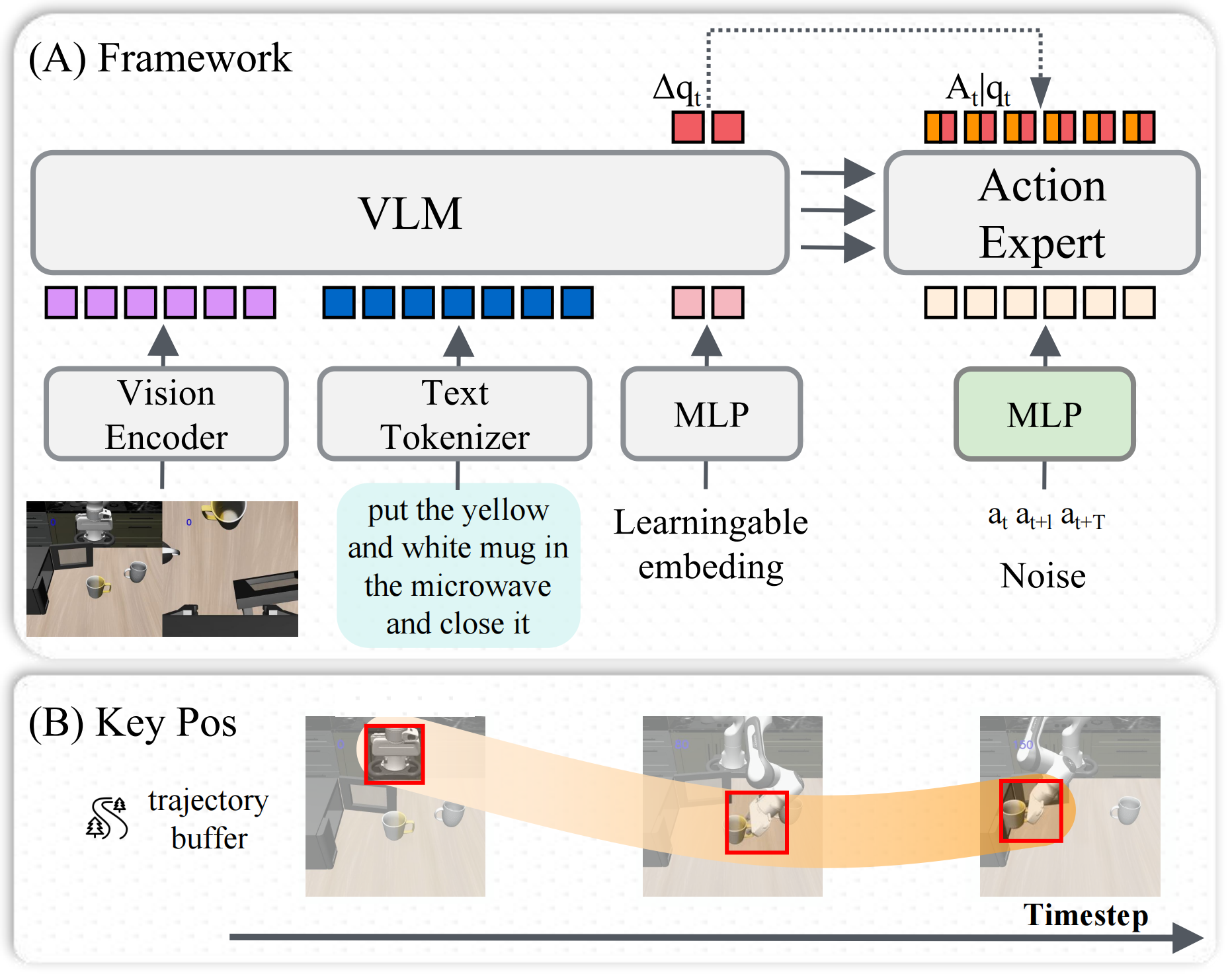
Key components
(1) Sparse Anchor Prediction
- Predict $K$ future Δ-position anchors
- Represent trajectory structure in a compact form
(2) Action Augmentation
- Concatenate state-related physical quantities (e.g., Δ-positions) to the action vector
- Enable joint prediction of state and action, providing implicit alignment between state space and action space
(3) Corridor Loss
- Defines a tolerance region over the predicted trajectory
- Penalizes deviations outside the region while allowing smooth convergence within it
👉 Behaves like a structured smooth-L1 in trajectory space
📊 Results
LIBERO-Plus (GR00T-based)
| Variant |
Description |
AVG |
| base |
|
75.23 |
| c1 |
query=3 |
77.25 |
| c2 |
+ extra data |
77.25 |
| c3 |
+ Δpos anchors |
79.21 |
| c4 |
+ corridor loss (CorridorVLA) |
83.21 |
📈 Improvement:
- +7.98% over baselines
- Largest gain from explicit spatial constraint
⚙️ Implementation
📌 Key Insights
Spatial guidance can be:
- explicit (loss-level) instead of implicit (feature-level)
Physical quantities are:
- more action-aligned
- more interpretable
Simple constraints can:
- significantly improve stability
- reduce unstructured exploration
📖 Citation
If you find this work useful, please cite:
@article{corridorvla2025,
  title={CorridorVLA: Explicit Spatial Constraints for Generative Action Heads via Sparse Anchors},
  author={Dachong Li and ZhuangZhuang Chen and Jin Zhang and Jianqiang Li},
  year={2026},
  eprint={2604.21241},
  archivePrefix={arXiv},
  primaryClass={cs.RO},
  url={https://arxiv.org/abs/2604.21241}
}

